"Average check" is the amount a customer spends on average at a restaurant. Every business owner wants to increase it. But many restaurants go the wrong way about it: they try to sell more.
Yet what increases the average check is not pressure. What increases the average check is asking the right questions, understanding the need, and helping the guest make a decision.
Good sales is not about "pushing". Good sales is seeing what is missing at the guest's table, reading their need, and giving the right offer at the right moment.
1. Wrong approach: “The more I offer, the more I sell”
An inexperienced waiter thinks that the more products he mentions, the more sales he will make. This is often wrong.
The guest does not come to the restaurant only to eat. He wants to sit comfortably, make decisions, talk, and feel good. When a waiter offers a new product every three minutes, the guest perceives this not as service but as pressure.
The result of pressure selling:
- the guest becomes uncomfortable;
- a feeling of “they are pushing something on me” arises;
- the risk of complaints increases;
- the check might be larger that day, but the guest does not return.
The average check should not be considered only for one table. The main question is: will this guest come again?
2. The right approach: find the need
Good sales is actually help.
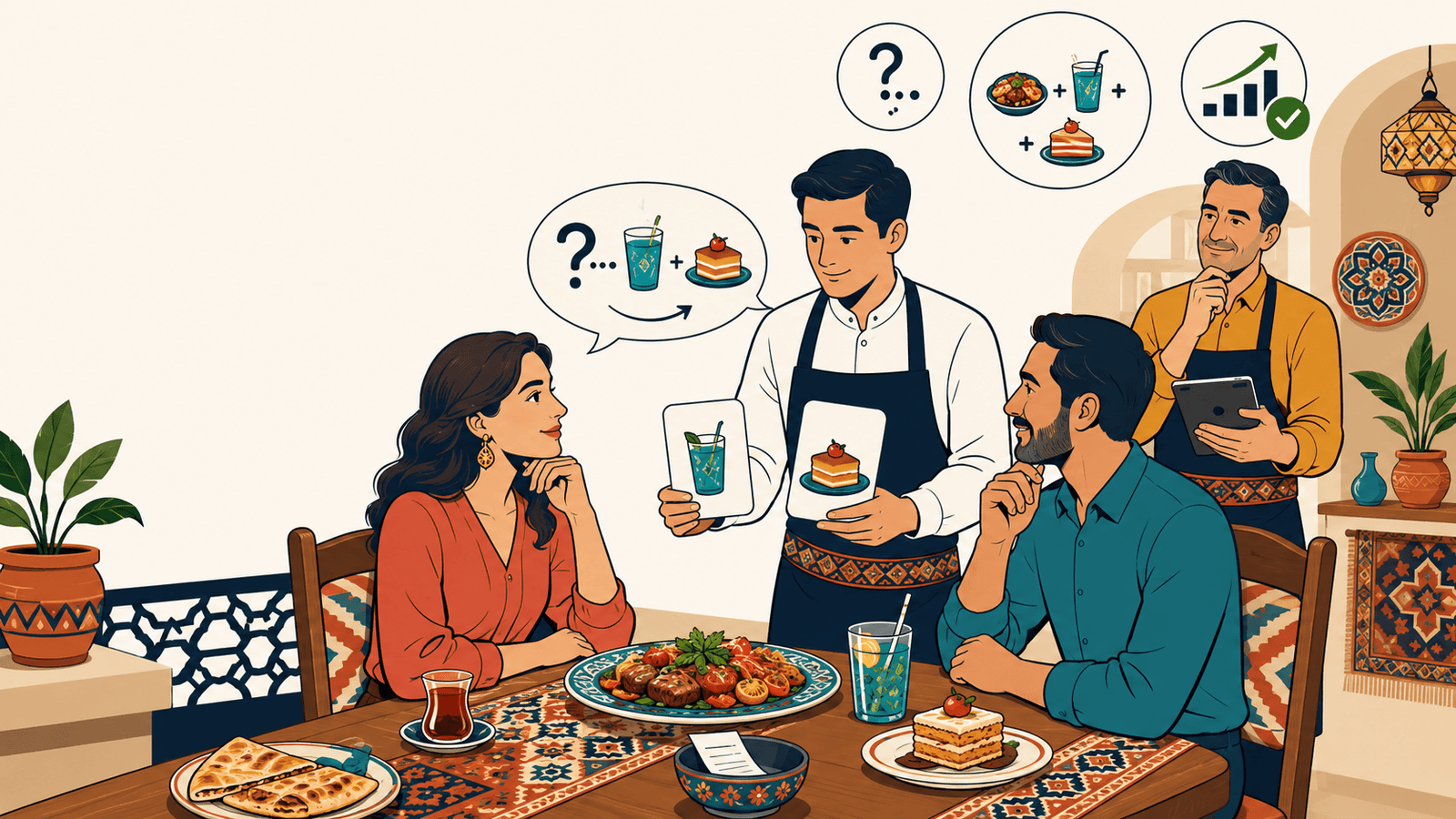
The waiter's job is not to extract more money from the guest's pocket. His job is to find the need that will complete the guest's experience. And this is done by asking questions.
A waiter who correctly reads whether the guest is in a hurry, came with family, is the host of a banquet, is in the restaurant for the first time, is unfamiliar with the menu, is budget-conscious, or is celebrating a special occasion, is more successful in sales.
People easily buy a product that is offered according to their need, not one that is forced upon them.
3. The Art of Open-Ended Questions
A closed question gives the guest the chance to say "no":
- "Would you like a drink?"
- "Would you like dessert?"
- "Is there anything else?"
- "Are you taking a salad?"
An open and guiding question makes the guest think about their choice:
- "What would go better with this meal – a cold drink or buttermilk?"
- "Should I bring a light salad or a hot appetizer alongside your meat dish?"
- "Shall we serve the dessert after the meal, or together with tea?"
- "Would you prefer a spicy or milder flavor for you?"
- "Are you in the mood for a lighter meal today, or shall we go for a filling option?"
The waiter does not pressure the guest; they help them decide.
💡 Useful tip: Turn a closed question into an open choice. Instead of "Water?" say "Still, sparkling, or room temperature water?"; instead of "Dessert?" say "Our house dessert, which is the most popular choice, goes well with tea – shall I bring it?"; instead of "Large size?" say "Standard portion, or a large portion for sharing?" The goal is not to pressure the guest, but to create a comfortable choice for them.
4. Read the customer: when to offer, when to keep silent
If half of good sales is talking, the other half is knowing when to keep silent.
You can suggest
- If the guest looks at the menu for a long time.
- If they seem undecided.
- If they say “What do you recommend?”
- If they order for sharing as a family or group.
- If the meal is missing a drink, salad, or extra sauce.
- If the guest is celebrating a special day.
It is better not to offer
- If the guest says "that's all."
- If the guest indicates they are in a hurry.
- If the guest clearly shows they are budget-conscious.
- If the guest has already said "no" once.
- If the table seems tense or uncomfortable.
- If it becomes necessary to offer a product to a child without parental consent.
A good waiter is not only someone who knows the menu; it is someone who reads the psychology of the table.
5. Azerbaijan reality: the biggest risk in banquet sales
One of the most serious risks regarding the average check in our market arises from banquets and large table orders.
The banquet host wants to save money upfront: “Write less, we’ll sort it out later.” However, after the guests arrive, they may say: “Don’t leave any empty space on the table,” “Give guests whatever they want,” “Don’t hold back on the drinks.”
The waiter sees this as a sales opportunity. Food, drinks, extra snacks, fruit, desserts, and tea increase. At the end of the night, the argument begins: “What is this bill?”, “I didn’t say that,” “Who authorized this?”
The problem here is not sales, but uncontrolled sales.
The Golden Rule at a Banquet
At a banquet, every additional order must be confirmed with the host or a pre-designated responsible person:
- a responsible person is selected before the banquet;
- additional orders are written only with that person's approval;
- the host is informed at critical stages;
- a limit is set for drinks and extra food;
- no surprise bill at the end of the night.
The waiter's job is not "how much more can I write down." Their job is to manage the table, satisfy the guest, and keep the host informed about the bill.
6. Risky guest groups: not everyone gets the same sale
Offer for children
It is risky to directly ask a child, "Do you want ice cream?" or "Should I bring dessert?" The child may say "yes," but the decision-maker is the parent.
The right approach: "If you want a light option for the child, we have a suitable option on the menu." The offer is made to the parent, not the child.
Elderly and budget-constrained guests
It is necessary to state the price openly and offer choices to these guests:
- “We also have a simpler and more affordable option.”
- “This product is a larger portion, and the price is different.”
- “If you wish, I can offer a more economical option for sharing.”
This is both sales and respect.
Young guests and bill risk
Some young guests order casually to impress the other party, but struggle when the bill arrives. Staff should not add extra orders without confirmation, should not hide the price of expensive items, and must inform the manager when sensing a bill risk.
Sales are good, but if there is a risk that the bill won't be paid, that is no longer a sale — it's an operational risk.
7. Combo menu: the simplest system to increase average check
Combo menu offers the guest a ready and logical package instead of making them choose item by item:
- burger + fries + drink;
- qutab set + ayran + salad;
- breakfast + tea;
- coffee + croissant;
- soup + main course + compote;
- family set for four.
The guest does not think "what else should I order?" The restaurant prepares a logical combination in their place.
The combo must be set up correctly: the guest must feel a real benefit, the products must complement each other, the price must look reasonable compared to buying separately, and the staff must explain the combo simply.
Combo menu is not a price reduction; it is a system of decision simplification and basket selling.
8. Price psychology: build choice architecture
The average check doesn't only grow with the waiter's speech. Menu pricing is also part of sales.
For example:
- Small: 4.50 AZN
- Medium: 5.50 AZN
- Large: 6.00 AZN
The customer sees a one manat difference between small and medium, but only 50 qepik difference between medium and large, and may consider the large size more logical. The restaurant doesn't force the guest; it builds choice architecture.
This method can be applied in standard/large portions, single product/drink menu, simple/premium breakfast, classic burger/burger set, and tea/tea + dessert options.
The main principle is this: when the guest moves to a higher option, they must see real value.
9. Avoid the phrase “Do you want to buy?”
Sentences like “Do you also want to buy this?”, “Will you buy dessert?” and “Are you getting anything extra?” put the guest on the defensive.
More professional expressions:
- “The most suitable drink to complement this dish is ayran, shall I bring it?”
- “I would recommend a light dessert before the tea.”
- “This portion might be a bit small for two people, the larger option for sharing would be more convenient.”
- “If you prefer a more filling option, this set is more suitable.”
- “Shall we arrange a light snack on the table until your guests arrive?”
The difference in language changes the outcome of the sale.
10. 6 Rules to Prevent Complaints
- Offer once. If the guest says "no", do not pressure.
- Don't hide the price. The price of expensive products must be transparent.
- Speak to the parent, not the child. Get the decision from the parent.
- Inform the host at a banquet. Get confirmation for additional orders.
- Don't pressure elderly and sensitive guests. Think about comfort before sales.
- Don't train staff with the mindset "the more you write, the better". This approach damages brand reputation.
11. System for the entrepreneur: average check not left to chance
The average check should not be left solely to the waiter's skill. The system should cover the following:
- menu engineering;
- combo menus;
- price tiers;
- staff sales training;
- banquet additional order procedure;
- complaint management procedure;
- daily average check analysis;
- product-wise sales report;
- performance bonus model.
Telling the waiter "sell" is not enough. They need to be taught what, when, to whom, and how to offer.
Conclusion
Increasing the average check is not the art of pressure. It is the art of asking questions, understanding needs, building choices, and managing risk.
Proper sales do not disturb the guest; they provide a better experience. Do not sell to the guest — help them. Do not leave extra orders at banquets unchecked. Do not pressure sensitive guest groups. Simplify decisions with combo menus. Structure choices wisely with price tiers. Prepare staff not just for service, but for a sales culture.
When this happens, the average check grows, complaints decrease, and the guest returns.
🔧 Useful tools: Measure the sales and profit power of products with the Menu Matrix; check the outcome of offer and combo scenarios with the Break-even Calculator.
How does DK Agency help?
DK Agency helps restaurants turn average check increase from random sales behavior into a system.
We do not view this topic merely as a question of “what should the waiter say?” The system covers menu engineering, combo menu design, price tiering, banquet sales procedure, open-ended question training for the service team, complaint risk reduction, average check and product sales analysis, and a staff motivation model — all combined.
Because sales is not pressure. Sales is the result of a properly built guest experience.
Next step: If you want to increase your team's sales skills and grow the average check systematically, contact DK Agency / TQTA for training programs →