Category: 🎨 Concept & Brand | Reading time: 10-12 min
An entrepreneur goes to a designer: "I need a logo." The designer draws a logo — nice colors, font, icon. The entrepreneur is satisfied. "Our brand is ready!" he says.
Your brand is not ready.
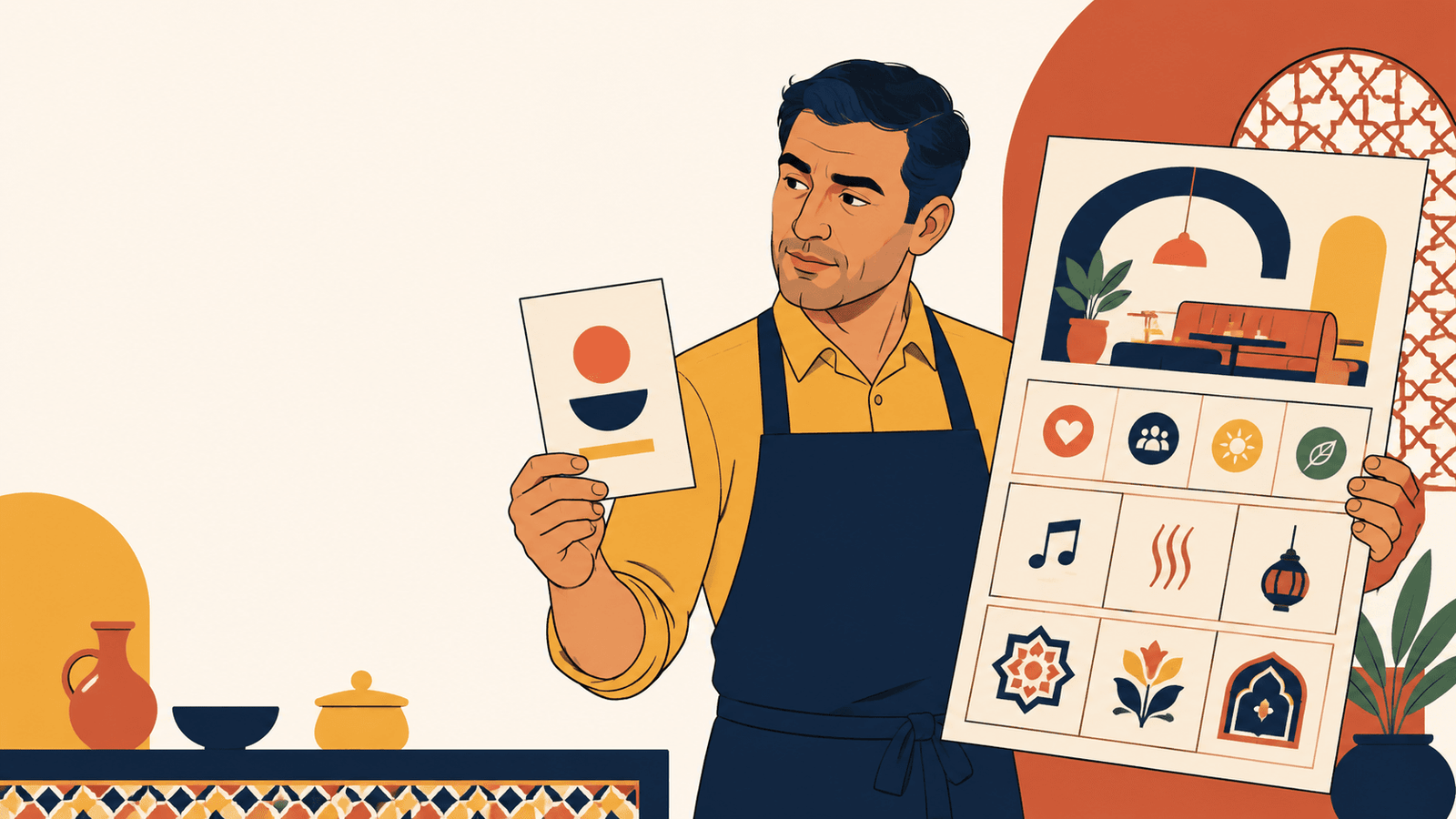
A brand is not a logo. The logo is the face of the brand — but the brand itself is feeling. What does the customer feel when they remember your restaurant? What comes to mind? What emotion arises when they hear the name? That is the brand.
Starbucks' logo is a siren — beautiful. But what makes Starbucks Starbucks is not the siren. It's the "third place" concept — a place to relax between home and work. Howard Schultz created that, delivering the same feeling in 35,000 stores.
Your restaurant also gives a feeling — either intentionally or by accident. In this article, we teach you how to create that feeling on purpose.
What is a brand? 3 levels
Level 1: Visual Identity (visible)
- Logo, colors, font
- Menu design
- Interior, decor
- Employee uniform
- Packaging, signage
- Social media visuals
This is the easiest part of the brand. A designer prepares it, and it's done.
Level 2: Language and tone (audible)
- How do you speak to the customer?
- What language do you use on social media?
- How are menu descriptions — formal? informal? playful?
- How do you answer the phone?
Example:
-
❌ "Hello, you've called X restaurant, how can I direct you?" (you're not a bank)
-
✅ "Hello! Welcome to X restaurant, what can we do?" (warm, informal)
-
❌ Menu: "Chicken fillet 250g, with garnish" (hospital menu)
-
✅ Menu: "Grilled chicken fillet — with a special spice blend, with buttery potatoes" (tells a story)
Level 3: Culture and values (felt)
- How do employees approach the customer?
- How is it resolved when there's a problem?
- What does the business owner believe in — how is this reflected in the team?
- What does the customer feel when leaving?
This is the most difficult but most valuable part of the brand. A designer cannot create it — you create it.
Brand = Making a Promise
Every strong brand makes a promise — and keeps that promise every single time.
| Brand | Promise | How it keeps it every time |
|---|---|---|
| McDonald's | Fast, consistent, same taste | Speedee System, standard recipe |
| Starbucks | Cozy "third place" | Same atmosphere, same language, same cup |
| Ritz-Carlton | Perfect service | "Ladies and Gentlemen" culture |
| Nusret | Show, experience, status | Dramaturgical service, social media effect |
What does your restaurant promise? If you can't answer that question in one sentence — you have a brand problem.
Examples:
- "Baku's freshest seafood — in a calm, family setting"
- "Fast, cheap, filling — ideal for a worker's lunch"
- "Modern interpretation of Azerbaijani cuisine — for special evenings"
Write that sentence. Stick it on the wall. Look at that sentence in every decision — menu, decor, music, staff uniform, social media — everything must align with that sentence.
7 elements of visual identity
1. Logo
- Keep it simple — should be readable on a small tablet, business card, or packaging
- Must have a color version and a black-and-white version
- Align with the concept — bold for fast-casual, minimal for fine-dining
2. Color palette
- Maximum 3-4 main colors
- Main color + secondary color + accent color
- Colors create emotion: red = energy/appetite, blue = trust, green = freshness, black = luxury
3. Typography (font)
- Maximum 2 fonts — 1 for headings, 1 for body text
- Must be legible — in menus, price boards, social media
4. Photography style
- Food photos should be in the same style — lighting, angle, background
- Best option: a 1-day shoot with a professional photographer — shoot the entire menu
5. Menu Design
- Combine with the rules from our menu engineering article
- Colors, fonts, and layout consistent with visual identity
6. Social media templates
- Ready templates for Instagram, Facebook posts
- Same color, same font, same style — creates recognition
7. Packaging design
- Delivery containers, napkins, packages — make them branded
- Even a small sticker makes a difference
Online brand — social media strategy
In 2026, if a restaurant is not on social media — it doesn't exist. But social media does not mean "1 post per day." Strategy is needed.
Which platform?
| Platform | Why | What to share |
|---|---|---|
| Visual, younger audience | Food photos/videos, atmosphere, behind-the-scenes | |
| TikTok | Viral potential, Gen Z | Short kitchen videos, "day in the life" format |
| Google Business | Visibility in search | Photos, business hours, reviews |
| 30+ age group | Campaigns, events, menu updates |
Content rules:
- 80/20 rule: 80% value-giving content (food, atmosphere, story), 20% sales (campaign, discount)
- Show people: Chef working, waiter smiling — people look at people
- Create a sense of place: Video with music, lighting, customers' joy — create a "I want to be here" feeling
- Respond to reviews: Both positive and negative. Professional response to negative — protects brand image
Word-of-Mouth Marketing — The Strongest Channel in Azerbaijan
In Baku, acquiring customers with an advertising budget is difficult — because people trust ads very little. But they trust their friend's word. This is an expanded version of the "booking banquets from banquets" principle we discussed in our "Hidden Costs" article.
How to strengthen word-of-mouth marketing:
-
Exceed expectations. Standard service does not bring recommendations. Do something unexpected — a free small dessert, "here's some tea on us", a birthday surprise. Will Guidara calls this "unthinkable hospitality".
-
Create a "shareable moment". A plate design worth photographing for Instagram, a unique serving style, an eye-catching decor element. People photograph it, share it — free advertising.
-
Maintain customer connection. WhatsApp group, loyalty card, birthday message — the message "you are important to us".
-
Book banquets from banquets. Apply the rules from our "Hidden Costs" article — call after 3 days, VIP card, discount on the next banquet.
BRANDING CHECKLIST
| # | Item | Status |
|---|---|---|
| 1 | Write the restaurant's one-sentence "word" | ☐ |
| 2 | Define the target audience profile (age, income, lifestyle) | ☐ |
| 3 | Prepare logo (color + black-and-white) | ☐ |
| 4 | Define color palette (max 3-4 colors) | ☐ |
| 5 | Choose font (max 2 fonts) | ☐ |
| 6 | Align menu design with brand identity | ☐ |
| 7 | Do food photography (professional) | ☐ |
| 8 | Prepare social media templates | ☐ |
| 9 | Create/update Google Business profile | ☐ |
| 10 | Conduct "brand language" training with employees | ☐ |
| 11 | Brand packaging materials | ☐ |
| 12 | Plan word-of-mouth strategy (referral, VIP, surprise service) | ☐ |
💡 DK Agency: Do you want to build a restaurant brand? The DK Agency team offers full service from concept analysis to visual identity strategy, from social media planning to employee brand training.
📧 info@dkagency.com.tr | 🔧 dkagency.com.tr/aletler | 🌐 dkagency.com.tr/aletler/marketinq-ocagi
HOWARD SCHULTZ
“We don't sell coffee. We create a third place between home and work.”
📖 Source: Pour Your Heart Into It
Simon Sinek
“People don't buy WHAT you do, they buy WHY you do it.”
📖 Source: Start With Why
SETH GODIN
“People don't buy products, they buy stories. A product with a story is a brand.”
📖 Source: All Marketers Are Liars
DANNY MEYER
“Brand is what people say about you when you are not talking about yourself.”
📖 Source: Setting the Table