
Category: 🔧 Operations & Hygiene | Reading time: 10-12 min
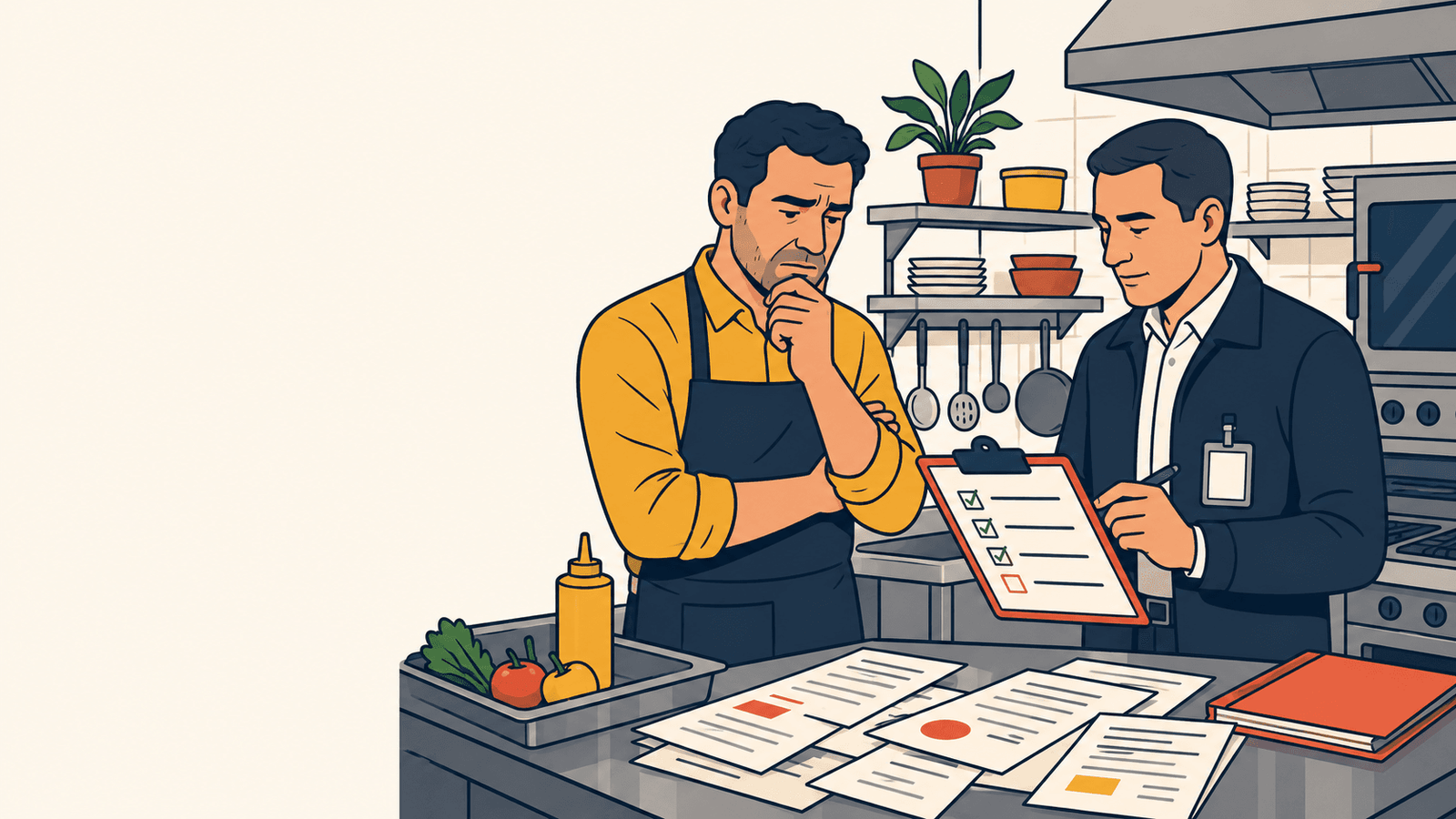
One day, an AQTA (Azerbaijan Food Safety Agency) inspector walks in the door. He gives no warning. He comes as per his schedule. He conducts an inspection for 45 minutes. And you end up with a fine — because you weren't ready.
This happens every day in Baku. The business owner says "we'll fix it later," and then a fine ranging from 500₼ to 5,000₼ is issued. Sometimes operations are suspended. In the worst case — the facility is closed.
In this article, I will write down one by one what AQTA checks, what violations it fines, and what you need to do to make your restaurant/cafe/tea house fully ready. Print the checklist, stick it on the wall.
What does AQTA inspect? 8 main areas
1. Food storage conditions
- Refrigerator temperature: Must be between +2°C and +6°C. The inspector checks with a thermometer.
- Freezer temperature: -18°C or lower.
- Raw and ready-to-eat food must be stored separately. If raw chicken drips onto a prepared salad — a fine.
- Food must be stored at least 15–20 cm above the floor — on a shelf or pallet.
- FIFO (First In, First Out) rule: Older food in front, newer behind. A date label on every container.
- Expiration dates: If expired food is found — serious violation.
⚠️ Warning: Even if the refrigerator temperature is correct, if the door does not close tightly — the temperature fluctuates, food spoils, and a fine is issued. Regularly check the refrigerator door gasket.
2. Personal hygiene
- Medical certificate: Every employee must have a current medical certificate. Inspector asks, if you cannot show it — fine.
- Work clothing: Clean, light-colored, closed-top. A kitchen worker must have a head covering (hairnet).
- Hand washing: In the kitchen, there must be a separate hand washing sink (it must not be the same as the food washing sink). Soap, drying towel, disinfectant.
- Nails, jewelry: Long nails, nail polish, rings, bracelets — prohibited in the kitchen.
- Tobacco: Strictly prohibited in the kitchen and food storage areas.
3. Kitchen hygiene
- Work surface cleanliness: Cutting boards, tables, knives — must be cleaned after each use.
- Color-coded cutting boards: Red for raw meat, green for vegetables, white for bread, etc. Cutting raw chicken and salad on the same board is a serious cross-contamination risk.
- Trash bins: Lidded, pedal-operated. Overflowing trash — fine.
- Pest control: Cockroaches, mice, flies — there must be no trace of them. The inspector checks the area.
4. Water quality
- Drinking water: If mains water is used, a filtration system must be in place.
- Ice: The ice machine must be clean; ice must not be taken by hand (use tongs or a scoop).
5. Food preparation process
- Cooking temperature: Chicken must reach a minimum internal temperature of 74°C. Beef (well-done) 71°C. The inspector can check with a thermometer.
- Storage temperature: Prepared food should not remain at room temperature for more than 2 hours. After 2 hours, it must either be refrigerated or discarded.
- Reheating: If pre-prepared food is reheated, it must reach above 74°C.
6. Documentation
- AQTA registration: You must register with AQTA to operate. It is free via ASAN Service or KOBİA.
- Hygiene journal: Daily temperature records, cleaning logs. The inspector requests the journal.
- Food source: A document (invoice, receipt) showing where each food item was purchased. Traceability requirement.
7. Hall and common areas
- Toilet: Clean, soap, dryer, running water. Separate entrance from kitchen.
- Ventilation: No odor should pass from the kitchen to the hall.
- General cleanliness: Floor, walls, ceiling — general sanitary condition.
8. Allergen (allergen) information
The menu must contain allergen information — nuts, milk, gluten, eggs, etc. This requirement is getting stronger.
Most common reasons for fines
The most common violations recorded by AQTA inspectors in Baku:
| # | Violation | Fine risk |
|---|---|---|
| 1 | Lack of medical certificates | High |
| 2 | Expired food found | Very high |
| 3 | Refrigerator temperature outside norm | High |
| 4 | Storing raw and ready-to-eat food together | Very high |
| 5 | Lack of hand washing facilities | High |
| 6 | Lack of hygiene log | Medium |
| 7 | Finding traces of pests | Very high |
| 8 | Lack of food source documents | Medium |
| 9 | Inappropriate work clothing | Medium |
| 10 | Inadequate toilet sanitation | High |
Daily, weekly, monthly hygiene regimen
Every day:
- ☐ Check refrigerator/freezer temperatures, log in journal
- ☐ Clean and disinfect work surfaces
- ☐ Empty and clean trash bins
- ☐ FIFO check — any expired food?
- ☐ Check hand washing stations — soap, dryer available?
- ☐ Check employees' work attire
Every week:
- ☐ Clean the inside of refrigerators thoroughly
- ☐ Pest inspection — check all corners, behind shelves
- ☐ Check cutting boards — cracks, signs of rot?
- ☐ Check the ventilation filter
- ☐ Deep check toilet hygiene
Every month:
- ☐ Check the validity of medical certificates — are any due for renewal?
- ☐ Archive food source documents — are invoices stored correctly?
- ☐ Check the technical condition of all equipment — ovens, refrigerators, dishwashers
- ☐ Conduct a short hygiene briefing for employees (15 minutes is enough)
- ☐ Call pest control service (professional disinsection)
"AQTA Preparation" checklist — stick to the wall
Print this list, stick it at the kitchen entrance. Check daily.
| # | Item | Daily ☐ |
|---|---|---|
| 1 | Refrigerator: +2°C — +6°C | ☐ |
| 2 | Freezer: -18°C and below | ☐ |
| 3 | Raw/ready-to-eat food is separated | ☐ |
| 4 | Food is stored off the floor | ☐ |
| 5 | No expired food | ☐ |
| 6 | FIFO rule is followed | ☐ |
| 7 | Work surfaces are clean | ☐ |
| 8 | Trash bins are empty, with lids | ☐ |
| 9 | Hand washing: soap, dryer available | ☐ |
| 10 | Staff attire is appropriate | ☐ |
| 11 | Hairnet (bonnet) is worn | ☐ |
| 12 | Temperature log is filled out | ☐ |
| 13 | Toilet is clean | ☐ |
| 14 | Ventilation is working | ☐ |
| 15 | No signs of pests | ☐ |
⚠️ Warning: AQTA permit is FREE. Some "intermediaries" ask for 150-300₼ — DON'T PAY. Go to the ASAN Service center or KOBİA house yourself, fill out the forms.
Cross-contamination — the most dangerous, least known risk
Cross-contamination is the transfer of bacteria from raw food to ready-to-eat food. This is the #1 cause of food poisoning.
Most common ways:
- Cutting salad on a board where raw chicken was cut
- Touching bread without washing hands after handling raw meat
- Liquid dripping from raw meat onto ready-to-eat food in the refrigerator
- Touching raw and cooked food with the same gloves
Solution:
- Color-coded cutting boards: red = raw meat, green = vegetables, yellow = chicken, blue = fish
- Hand washing for 20 seconds with soap, every time you switch food items
- In the refrigerator, raw food on the bottom shelf, ready-to-eat food on the top shelf
- Glove changing rule — new gloves for each food group
💡 DK Agency: Not sure you are ready for an AQTA inspection? The DK Agency team performs a hygiene audit — we check every item an AQTA inspector looks at, provide a written report and a correction plan. Contact us for hygiene training, HACCP plan preparation, and documentation system setup.
📧 info@dkagency.com.tr | 🔧 dkagency.com.tr/aletler | 🌐 dkagency.com.tr/aletler/marketinq-ocagi
JON TAFFER
“I have never seen a failed restaurant — only failed businessmen. Hygiene problem = management problem.”
📖 Source: Bar Rescue
GORDON RAMSAY
“People think they go bankrupt because the kitchen was closed. In fact, they go bankrupt because the office was closed — meaning there is no hygiene, control, or documentation system.”
📖 Source: Kitchen Nightmares