Category: 📈 Sales & Delivery | Reading time: 10-12 min
"We joined Wolt, orders are coming, everything is great!" Is it great? Let's talk with numbers.
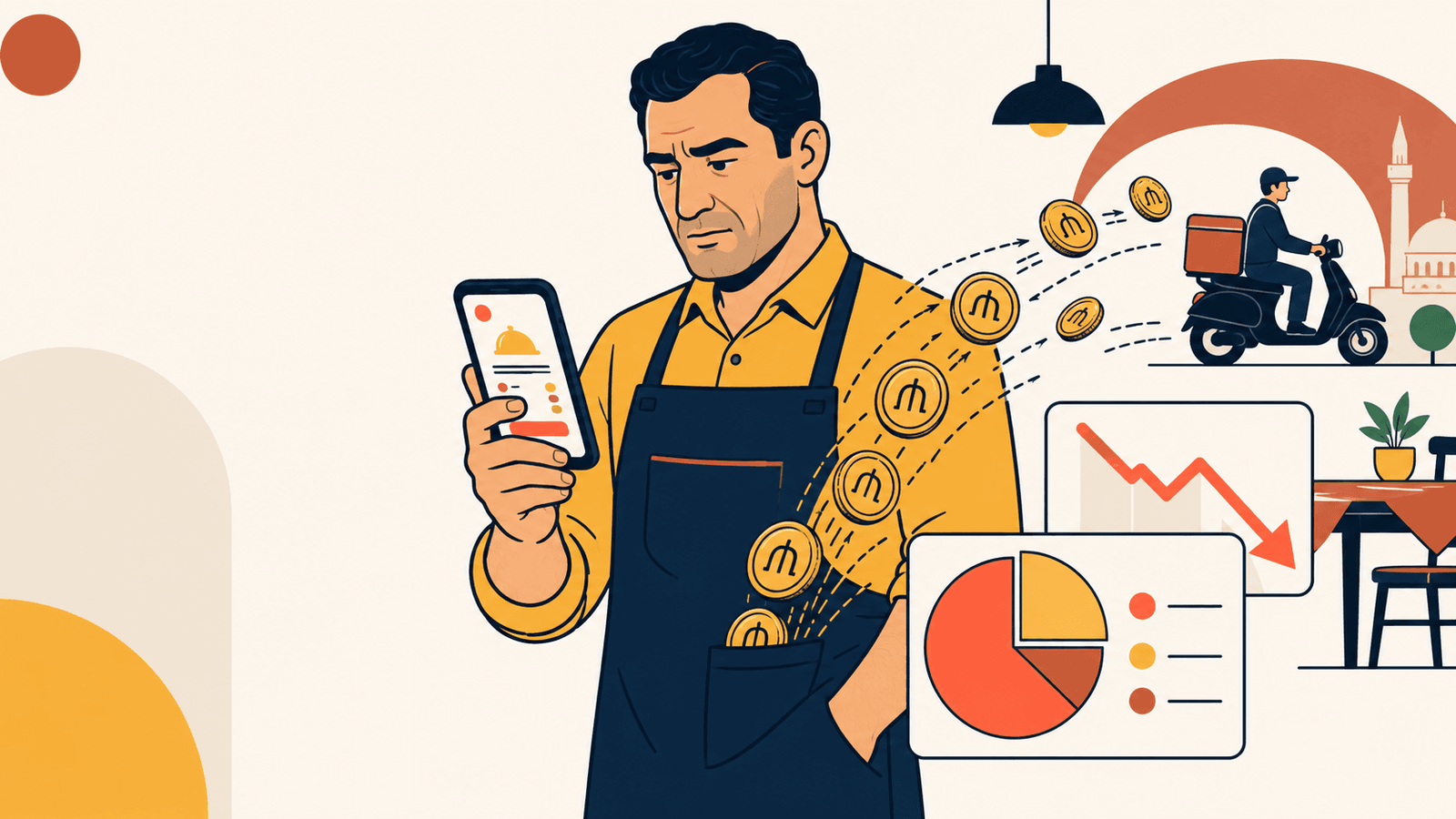
You received a 30₼ order from Wolt. Commission is 30%. Wolt took 9₼. You have 21₼ left. From that 21₼, food cost is 10₼ (food cost 33%). You have 11₼ left. Packaging material is 1.50₼. You have 9.50₼ left. Labor cost (preparation time) ~3₼. You have 6.50₼ left — before rent, utilities, taxes. After those? 2-3₼. Maybe 0₼. Maybe negative.
If the same order were placed in the restaurant: 30₼ all yours. No commission. No packaging. You would have 12-15₼ left.
Delivery platforms are not bad — but if you join without knowing the math, you can lose money on every order. In this article, I'm revealing that math.
Platforms' Commission Structure
Main delivery platforms active in Baku and approximate commission rates:
| Platform | Commission (approx) | Note |
|---|---|---|
| Wolt | 25-30% | Varies by contract |
| Bolt Food | 25-30% | Varies by contract |
| Yango Deli | 20-30% | Discounts may apply to gain market share |
These figures may vary depending on the contract, order type, and promotions. Be sure to read your own contract — especially the fine print.
⚠️ Warning: Some platforms charge part of the discount to your account in promotional campaigns. That is, the platform runs a "20% off" campaign, but you cover half of the discount. This is written in the contract — read it.
Real calculation — 100₼ delivery vs restaurant sales
| Item | Restaurant (dine-in) | Delivery |
|---|---|---|
| Sales | 100₼ | 100₼ |
| Platform commission (30%) | 0₼ | -30₼ |
| Net revenue | 100₼ | 70₼ |
| Food cost (33%) | -33₼ | -33₼ |
| Packaging | 0₼ | -5₼ |
| Labor cost | -25₼ | -28₼ |
| Other operating expenses | -25₼ | -15₼ |
| Net result | +17₼ | -11₼ |
This calculation is a shock — but it's real. If your food cost is high and you haven't adjusted your prices, delivery can make you lose money on every order.
So why does everyone do delivery?
Good question. Because delivery has values other than direct profit:
- Customer base expands — you reach people who don't come to your restaurant
- Brand visibility — being on the platform creates a free advertising effect
- Additional revenue during slow hours — the restaurant is empty between 14:00-17:00, delivery fills it
- Acquiring new customers — someone who likes your delivery may later visit the restaurant
- Kitchen utilization — the kitchen doesn't sit idle, staff are always busy
But these benefits only work if you set up the math correctly. Otherwise, as volume increases, losses increase.
7 ways to make delivery profitable
1. Create a separate delivery menu
Do not connect the entire menu to delivery. Only select dishes with low food cost, suitable for packaging, and that maintain quality during transportation.
Suitable for delivery: Burger, wrap, pizza, plov, qutab, pasta, cold sandwich
NOT suitable for delivery: Ice cream (melts), fried fish (gets soggy), steak (cools down, quality decreases), soup (spills)
The delivery menu should be 40-60% of the restaurant menu — only the profitable and transportable part.
2. Increase the delivery price
Many restaurants write prices 10-20% higher on their delivery menu. Customers accept this — because they pay for convenience. Platforms allow it.
Example:
- At the restaurant, Chicken Sac: 18₼
- On delivery, Chicken Sac: 21₼ (+17%)
This 3₼ difference compensates for part of the commission. Small change, big impact.
3. Sell combos (set menus)
Instead of selling individual items, sell combos: main course + drink + dessert. The total margin of a combo is higher than that of a single item. Moreover, the average order value (AOV) increases.
Example combo:
- Single burger: 12₼ (food cost 4₼, CM: 8₼)
- Burger combo (burger + fries + drink): 18₼ (food cost 5.50₼, CM: 12.50₼)
- Margin increase: 56%
On platforms, combo orders generate 30-40% higher AOV.
4. Optimize Packaging Cost
- Buy in bulk — 1000 units of containers is 30-40% cheaper than 100 units
- Standardize sizes — 3-4 container sizes should cover the entire menu, not 10 different sizes
- If you want eco-friendly packaging — include it in the price, don't lose it separately
- Branded packaging — even a small sticker creates brand recognition, the cost is minimal
5. Build your own delivery system — but don't rush
The power of platforms is bringing in customers. But if you have a loyal customer base — accept orders from your own website or via WhatsApp/Telegram, and deliver with your own courier. Commission: zero.
But do the math:
- Courier salary: ~800–1200₼/month
- Motorcycle/car costs: fuel, maintenance, insurance
- Order management system
- Without a minimum of 20–30 orders per day, your own delivery system is unprofitable
Strategy: Start on platforms → gain loyal customers → direct them to your own channel → gradually reduce dependence on the platform.
6. Strategically use platform promotions
Platforms regularly run "free delivery", "discount" campaigns. Attention:
| Promotion type | Who covers? | Your strategy |
|---|---|---|
| Platform's own campaign | Platform | ✅ Join — free advertising |
| Shared discount | 50/50 | ⚠️ Calculate — is it profitable? |
| Discount on your account | You | ❌ Be very careful |
7. Track your delivery data every month
| Indicator | This month | Last month | Trend |
|---|---|---|---|
| Total order count | |||
| Average order value (AOV) | |||
| Total delivery revenue | |||
| Commission payment | |||
| Packaging cost | |||
| Delivery food cost % | |||
| Net delivery profit |
Fill out this table every month. Delivery should be managed as a separate business — do not mix it with restaurant profit.
Attention When Signing Contracts with Platforms
Before signing a contract, ask these questions:
- What is the commission rate? Is it fixed, or does it vary by order type?
- What is the payment term? Weekly, monthly? Are there any delays?
- What are the terms of promotional campaigns? Who covers the discount?
- What is the contract duration? What are the exit conditions? Is there a penalty?
- Can I change prices? Can I set different prices in the delivery menu?
- How does the rating system work? How does a low rating affect us?
- How much are additional services (advertising, highlighting)? Is there an extra fee to "move up" on the platform?
⚠️ Warning: Show the contract to your accountant or legal advisor BEFORE signing. There may be hidden terms in the fine print — especially regarding promotional cost sharing and exit penalties.
DELIVERY CHECKLIST
| # | Step | Status |
|---|---|---|
| 1 | Learn the commission rate of each platform | ☐ |
| 2 | Create a separate menu for delivery (only suitable dishes) | ☐ |
| 3 | Increase prices by 10-20% in the delivery menu | ☐ |
| 4 | Prepare combo/set menus | ☐ |
| 5 | Buy packaging materials in bulk, calculate the cost | ☐ |
| 6 | Calculate delivery P&L separately each month | ☐ |
| 7 | Read the terms of platform promotions — whose account? | ☐ |
| 8 | Monitor average order value (AOV), try to increase it | ☐ |
| 9 | Show contract terms to the accountant | ☐ |
| 10 | Prepare your own delivery channel (WhatsApp/website) for loyal customers | ☐ |
💡 DK Agency: Would you like to optimize your delivery channel? DK Agency Toolkit has a delivery P&L template — it calculates each platform's profitability separately. Our consulting service is available for delivery menu strategy, pricing, and packaging optimization.
📧 info@dkagency.com.tr | 🔧 dkagency.com.tr/aletler | 🌐 dkagency.com.tr/aletler/marketinq-ocagi
ROGER FIELDS
“Every sales channel has its own mathematics. A channel that generates revenue may not generate profit — you can only see this with numbers.”
📖 Source: Restaurant Success by the Numbers
DAVID SCOTT PETERS
“Revenue lies to you. Profit tells the truth. Each channel — dine-in, delivery, banquet — must have its own profit account.”
📖 Source: Restaurant Prosperity Formula
ANTHONY BOURDAIN
“Luck is not a business model.”
📖 Source: Kitchen Confidential